Mexican Associations Woo U.S. Investors Amid Changes in USMCA, Investment Law


Antonio Ortiz-Mena argues that it is concerning for the Mexican military to weigh in on issues related to economic policy. Furthermore, there remains a risk that the United States will, at some point, pressure Mexico to block investments that do not pose a threat to national security. Unlike the Committee on Foreign Investment in the United States (CFIUS), Mexican legislation on foreign investment focuses on specific economic aspects, such as competition and market power, but does not explicitly address considerations related to national security. Ortiz-Mena points out that it would be naive to think this issue should not be addressed and that it is preferable to do so in an explicit and orderly manner, thereby avoiding improvisation.
Three Countries, One Deal


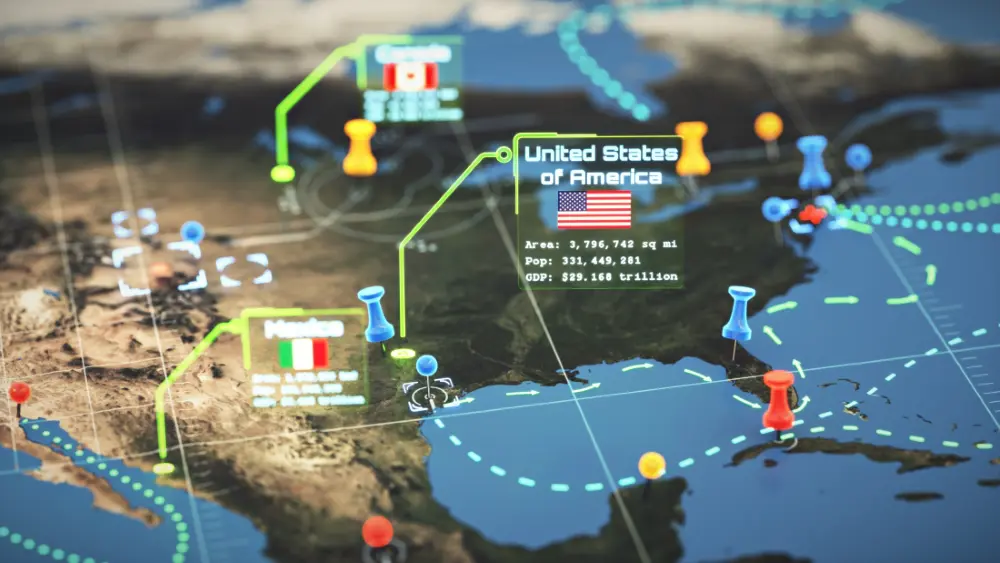
USMCA, which governs trade between Canada, Mexico and the U.S., entered renewed negotiations this summer. Photo Credit: Getty Images / matejmo

Antonio Ortiz-Mena argues that trust and security in North America—which are underpinned by trade—are at risk. It is important to build a region in which the three neighboring countries trust one another and continue to trade with one another. Furthermore, it is not desirable for governments to focus the debate on the trade deficit. On the contrary, it is essential that the conversation go beyond this issue.

Ortiz-Mena notes that Mexico’s priorities in the renegotiation of the United States-Mexico-Canada Agreement (USMCA) are divided into two central objectives:

  1. Increase the level of certainty in trade and investment rules, and explore the possibility of engaging in a dialogue on national security.
  2. Ensure that Mexico is the least disadvantaged nation at the USMCA negotiating tables.

In addition, Ortiz-Mena notes that relations between the United States and China were tense, which sparked a series of debates about how North American countries should prepare for the rise and consolidation of China’s economic growth on a global scale.


Protecting U.S. Medical Device Leadership Through Targeted Section 232 Action


The United States is at a pivotal moment in medical device trade policy. The authors argue that Medical devices warrant a differentiated rather than uniform Section 232 response. Also, the affordability consequences of Section 232 tariffs in this sector are real, proximate, and asymmetrically distributed. Finally, that origin differentiation is essential to a legally durable and strategically coherent Section 232 framework.


The Future of North America Trade Relations

ategory: Media Interview
Source: Georgia Tech


The Sam Nunn School is proud to present «The Future of North American Trade Relations,» an event featuring American, Canadian, and Mexican views on the state of play of North American trade. In the run-up to the review of the US-Mexico-Canada (USMCA) agreement in the summer, this half-day symposium takes stock of the stakes, issues, and prospects of the review.