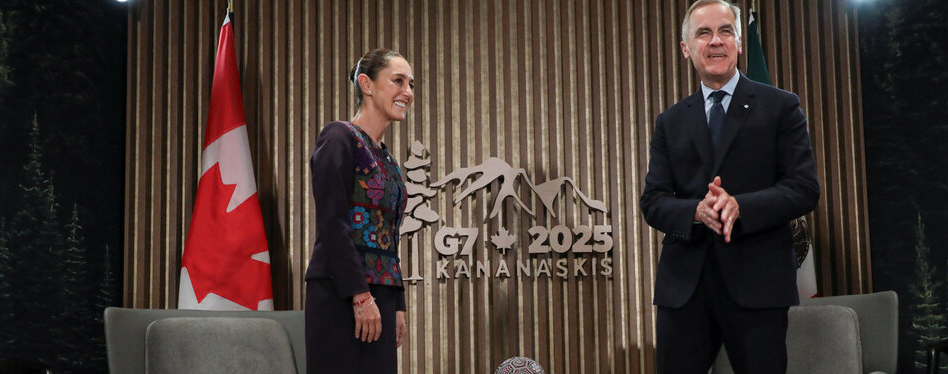
Facing Trump’s Threats, Mexico and Canada Draw Closer. Will It Last?
August 20, 2025
By: Emiliano Rodríguez Mega & Ian Austen
Source: The New York Times
Mexico and Canada have long viewed each other with indifference or even distrust. They’re now talking about teaming up.
Mexico and Canada, pushed into a three-nation trade deal by their powerful neighbor in between, have for decades viewed each other with a mix of disinterest and distrust.
Now, their leaders, driven by President Trump’s extensive new tariffs and threats to their countries’ sovereignty, are talking about ways to team up.
“It’s very much an all-hands-on-deck approach to ensure that we are kick-starting” the relationship, Canada’s foreign affairs minister, Anita Anand, told reporters this month, alongside Finance Minister François-Philippe Champagne.
“It sends a very strong signal when you have the foreign minister of a country and the finance minister come,” Mr. Champagne added. “I think that message is understood loud and clear in Mexico City.”
This month, the two Canadian officials led a delegation there to meet with President Claudia Sheinbaum of Mexico and prepare for a fall visit by Prime Minister Mark Carney of Canada. The encounter was largely seen as a chance to reset the relationship and compare notes for dealing with an increasingly aggressive Trump administration.
“What we have in common right now is a nefarious neighbor,” said Arturo Santa-Cruz, an expert on North American relations at the University of Guadalajara. “It makes a lot of sense that we collaborate.”
Just days before the trip, Mr. Trump suspended talks with Canada and punished the country with 35 percent tariffs, while offering Ms. Sheinbaum a 90-day extension to trade negotiations.
“I think he respects us,” Ms. Sheinbaum later told reporters. “And we respect him like neighbors.”
But the meetings this month suggest that neither Canada nor Mexico wants to rely on an unpredictable United States alone.
Historically, the two have had only distant economic and cultural ties, despite being trade deal partners. Mexico accounted for 1 percent of Canadian exports last year, and Canada represents around 3 percent of Mexico’s export market.
“This ménage à trois was made out of convenience, not love,” said Antonio Ortiz Mena, a professor at Georgetown University who held advisory roles as part of Mexico’s negotiating team in talks for the North American Free Trade Agreement of 1994. “Both countries, Canada and Mexico, have privileged the relationship with the giant in the middle rather than the relationship between us.”
For some, a sense of mistrust lingers. In much of Ontario, for example, Mexican factories are viewed as job stealers: As investment in auto plants flowed to Mexico and the southern United States over the years, production in Canada fell to 1.3 million vehicles last year from its peak of 2.9 million 25 years ago.
Recent frictions have also strained ties.
After Mr. Trump was elected in November, several Canadian politicians suggested that it may be time to leave Mexico behind and return to a one-on-one trade deal with the United States.
That idea vanished after Mr. Carney took office. He has stressed the importance of keeping all three countries in any deal, an opinion shared by Ms. Sheinbaum.
A few years after Canada and the United States signed a free trade deal, President George H.W. Bush opened negotiations with Mexico. Concerned that its new trade gains might be swiftly eroded, Canada joined the process. The result was NAFTA, which was altered to become the United States-Mexico-Canada Agreement championed by Mr. Trump.
Given that history, some analysts wonder whether recent talks will translate into concrete action, especially as a review of the U.S.M.C.A. approaches.
Even if Mexico and Canada manage to agree on an approach to maintain the trade deal — while trying to avoid the perception that the two countries are ganging up on the United States — there’s always the possibility that Mr. Trump chooses not to honor the terms, said Carlo Dade, a director at the University of Calgary’s School of Public Policy in Alberta.
The safest bet could be to persuade influential political and economic players in the United States that they have strong interests in protecting the region’s trade balance.
“The only thing that can contain Trump is America’s own powerful domestic actors; it’s the governors, it’s the big businessmen, it’s the party leaders,” said Jorge Schiavon, vice president of the Mexican Council on Foreign Affairs. “They are selfish allies, but they are those who defended the renegotiation in 2018, and they would do it again in 2025.”
The review of the 2020 agreement is set for next year, though Mexican officials have said consultations could begin as soon as this fall.
Some analysts and businesses also see hope for better trade, saying that Mr. Trump has at least somewhat respected the pact from his first term.
Nearly all exports traded under that deal are free of the 25 percent U.S. tariffs imposed on Mexican goods and the 35 percent tariffs on Canadian ones.
“It’s really a saving grace for Canada and Mexico,” said Jesse Rogers, an economist leading research on Latin America for Moody’s Analytics.
A recent study by his firm found that the effective tariff rate for both countries was around 13 percent. Without the exemption granted by the Trump administration, Mr. Rogers estimates, that would increase to around 40 percent for Canada and 32 percent for Mexico.
Emiliano Rodríguez Mega is a reporter and researcher for The Times based in Mexico City, covering Mexico, Central America and the Caribbean.
Ian Austen reports on Canada for The Times. A Windsor, Ontario, native now based in Ottawa, he has reported on the country for two decades.
Consulta la nota aquí: The New York Times